


The problem: maintenance by the calendar is not enough
A variable frequency drive is mostly semiconductors and copper, and those rarely wear out. Two parts do: the electrolytic capacitors of the DC bus and the cooling fans. They are the consumables, and replacing them on time is most of what preventive maintenance of a drive means.
Both age with heat, not with the date on the calendar. A drive in a cool, clean room can keep its capacitors twice as long as the same drive in a hot cabinet next to a furnace. That is why a single interval for every drive is either too early for some or too late for others.
- DC-bus capacitors dry out from the inside. Their life depends on the temperature of their core, which rises with the air around them and with the ripple current that passes through them.
- Cooling fans fail when the grease in their bearings ages. It ages faster when it is hot, only while the fan turns, and faster still in dust.
The calendar trap
| Clean room | Dusty cabinet | |
|---|---|---|
| Temperature | 25 °C | 45 °C |
| Load | 60% | 90% |
| Hours per day | 8 | 24 |
| Environment | Clean | Dusty |
| Supply unbalance | 0% | 2% |
| DC-bus capacitors | 15.0 yearsceiling of the estimate | 2.7 years |
| Cooling fans | 15.0 yearsceiling of the estimate | 2.0 years |
Same drive, same calendar.
Estimate it for your drive
Enter the real operating conditions — the air around the drive, its load, its running hours, its environment and the supply quality — to estimate how much life each component has left.
Advanced — if you know the parts (optional)
From the component datasheet. Left empty, the calculator uses typical values chosen by Wertek.Estimated time to renewal
Estimate, not a guarantee. It assumes the drive is energized 24 hours a day, runs the hours you enter at a constant load and temperature, and that its fans turn whenever it runs. Real drives do not run like that — which is the point of the last section.
The impact in numbers
Take a drive in a cabinet at 35 °C, at 75 % load, running 16 hours a day in a clean room. The calculator gives 11.9 years for the capacitors and 6.8 years for the fans. Now change one thing at a time:
- If the cabinet runs 10 °C hotter, the capacitors drop from 11.9 years to 6.0 years.
- With 2 % unbalance in the supply voltage, the capacitors drop from 11.9 years to 9.7 years.
- If the room is dusty, the fans drop from 6.8 years to 4.8 years.
If this drive stops today, how much does each hour of downtime cost your line?
Read the nameplate before you assume the age
The fans’ wear clock starts when the drive is installed and runs. The capacitors are different: they age on the shelf too. Before the first start, find out how long the drive has been without power.
What ages on the shelf and what does not
- DC-bus capacitors age without power: in storage their oxide layer degrades and their leakage current rises, faster the warmer the storage (Nippon Chemi-Con). That is what reforming repairs.
- Fans: their life is rated in operating hours (L10) — the hours they turn (ebm-papst, RS DesignSpark). The public sources consulted give no shelf-life rule for fans; for their wear, what counts is running time.
How to know how long it was stored
Compare the manufacturing date with the date it will be energized. The manufacturing date is on the nameplate or encoded in the serial number — for example, ABB documents which digits of its serial give the year and the week. Spare drives in a warehouse and drives switched off in the plant count too: what matters is the time without power. If the date cannot be established, treat it as the worst case and reform following the manufacturer’s procedure.
Source: ABB p. 8
How to store a spare drive
Capacitor manufacturers recommend storing at normal temperature and humidity, out of direct sunlight; heat speeds up the rise in leakage current (Nippon Chemi-Con). Keep the drive clean and dry, without condensation (ABB asks for this before reforming). Storage temperature changes the limit: one manufacturer allows 12, 24 or 36 months without power depending on whether it was stored at up to 50, 45 or 40 °C (Schneider Electric). And one manufacturer recommends, as best practice, powering stored drives regularly — about every six months — at rated voltage (KEB).
Situation → what to do
| Situation | What to do | Source |
|---|---|---|
| Less than 1 year without power | Start without reforming. | ABB p. 7 · KEB America |
| 1 to 2 years without power (up to 3 on some models) | Reform before use: power on without load for 30 minutes to one hour, as the manufacturer specifies. See reforming | ABB pp. 6, 9 · KEB America |
| More than 2 years (3 on some models) | Reform with a controlled circuit: current-limited or with the voltage raised gradually. See reforming | ABB pp. 6, 10 · KEB America |
| Manufacturing or storage date unknown | Treat it as the worst case: reform following the manufacturer’s procedure before energizing. See reforming | Wertek recommendation |
What to write down the day it enters service
The installation date — when it is energized in service — and, if it was reformed, the date and the method used. The calculator above counts life from the installation date: without it, every estimate starts in the wrong place.
In Wertek, the drive’s nameplate stores the installation date and the capacitor reforming date, in the asset’s record. Reforming does not renew the capacitors, so it does not reset their estimated life.
Stored for more than a year? Reform the capacitors before powering it
The wear clock starts when the drive is installed and energized, not when it was made — but a drive on a shelf is not idle for its capacitors. Drive manufacturers ask for the DC-bus capacitors to be reformed before full power if the drive has been without power for about a year or more. Skipping it can destroy them at the first start.
Why a stored capacitor needs it
In storage, the oxide layer that insulates an aluminum electrolytic capacitor slowly reacts with the electrolyte: the voltage it withstands drops and its leakage current rises, more so the warmer the storage. If full voltage is applied at once, the heat from that leakage current can break down the dielectric and open the capacitor’s pressure vent. A controlled voltage treatment rebuilds the oxide and brings the leakage current back down.
What drive manufacturers ask for
| Time without power | What the manufacturer asks | Source |
|---|---|---|
| Less than 1 year | No reforming needed. | ABB p. 7 |
| 1 to 2 or 3 years, depending on the model | Switch the drive on for 30 minutes without load before using it. | ABB pp. 6, 9 |
| More than 2 or 3 years, depending on the model | An external reforming circuit on the DC bus, current-limited (500 mA maximum), for the time the manufacturer specifies. | ABB pp. 6, 10 |
| 12, 24 or 36 months, if stored at up to 50, 45 or 40 °C | Apply mains voltage for one hour before starting the motor, with no run command possible meanwhile. | Schneider Electric |
| 1 to 2 years; more than 2 years | Operate the drive for one hour without modulation output; after 2 years, raise the input voltage slowly with a variable transformer. | KEB America |
Manufacturers do not draw the line the same way: by years and drive model, by years alone, or also by storage temperature. That is why the only valid procedure is the one from the manufacturer of your drive.
The procedure, in general terms
- Before starting: disconnect and lock out the supply, verify zero voltage from the input and DC terminals to ground, and never switch on the drive’s supply while a reforming circuit is connected (ABB, pp. 9, 11).
- Voltage is applied to the capacitors in a controlled way, never full voltage at once: current-limited — one manufacturer limits it to 500 mA, with the DC voltage at 1.35 to 1.45 times the drive’s nominal AC voltage, or raises it gradually from zero (ABB, p. 10) — or with the input raised slowly through a variable transformer (KEB).
- The time depends on how long it was stored: from 30 minutes or one hour for shorter storage to longer times set by the manufacturer for longer storage. The motor is not run and no load is applied.
- At the end, wait for the capacitors to discharge — one manufacturer specifies 5 minutes — and measure the DC bus close to zero before touching anything (ABB, p. 11).
What if I just leave it energized longer?
It helps, but only when the drive has been stored for a short time: that is the sources’ short method. ABB: 1 to 2 years off (up to 3 in some series), 30 minutes without load. KEB: 1 to 2 years, one hour without output to the motor. Schneider Electric: past its storage limit, which depends on temperature, one hour on mains voltage before starting.
After long storage — more than 2 or 3 years, depending on the source — more hours do not make it safe, because the problem is the first moment: when full voltage is applied at once to a degraded oxide, a large leakage current flows, the capacitor heats up and can fail right then (KEB; ABB, p. 7). What prevents it is raising the voltage gradually or limiting the current: a current-limited DC supply, a series resistor or a variable transformer (ABB, p. 10; KEB). That is why the sources change method after a certain time instead of asking for more hours.
Where powering without load does help, with no time window, is prevention: energize drives in storage about every six months at rated voltage (KEB), so they never need the controlled reforming.
High voltage. Reforming is done by qualified personnel, following the procedure of the manufacturer of your drive — its voltages, times and circuits. This page explains why; it is not a procedure.
From estimate to control with Wertek
The calculator assumes the conditions never change. Real drives run hotter in summer, change load with production and collect dust between cleanings. Wertek turns the estimate into a plan:
- Digitize the nameplate and the installation date — the date every estimate depends on.
- A maintenance plan that creates the work orders on their due date.
- Technicians receive the orders in the mobile app, record the work and close them.
Protect your critical drives
Registering the drive and its nameplate in Wertek is free. Scheduled work orders come with the paid plans.
What the estimate is based on
DC-bus capacitors: heat inside the capacitor
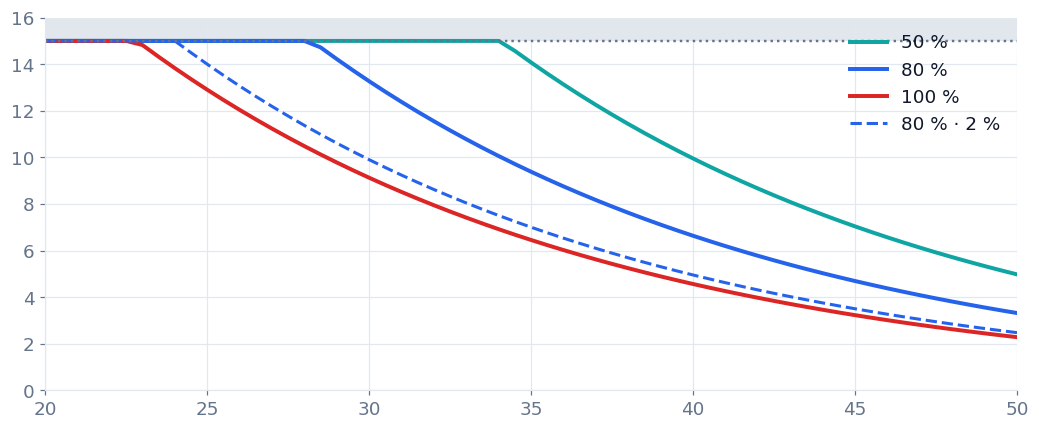
The life of an aluminum electrolytic capacitor depends above all on the temperature inside it. Capacitor manufacturers publish the rule: the cooler the core runs, the longer it lasts — roughly twice as long for every 10 °C cooler. Their estimation guides also stop at 15 years.
Inside a drive, that core temperature rises with three things: the air around the drive, the load (more current means more ripple heating the capacitor from inside) and unbalance in the supply voltage, which forces extra ripple through the DC bus. Hours stopped but energized also age the capacitor, only more slowly.
Cooling fans: the grease in the bearings
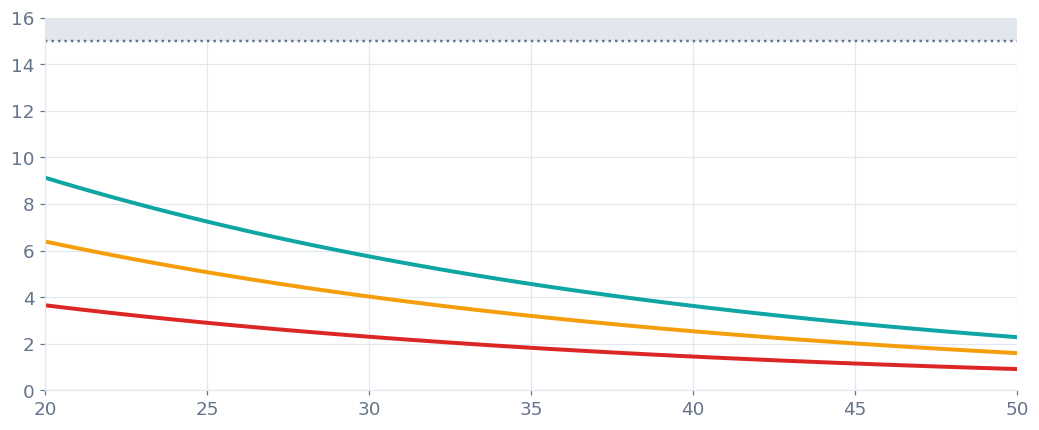
What usually ends a fan is the grease in its bearings. Fan manufacturers rate life as L10 — the hours after which one fan in ten has failed — and the industry rule is that grease life falls by about half for every 15 °C hotter.
The grease ages only while the fan turns, so hours of operation matter as much as the calendar. Dust shortens it further; there is no public law for how much, so that effect is Wertek’s own assumption and is meant to be corrected with field evidence.
What is public and what is Wertek’s own
The two rules above — heat halves the life of capacitors and of fan grease — are public, and the sources are linked below.
Wertek supplies the rest as its own assumptions, chosen for a typical industrial drive: how much warmer the air is inside the drive than around it, how much the load and the supply unbalance heat the capacitors, the typical rated life of the parts when you do not enter it, and how much dust shortens a fan. These are corrected as replacements are recorded. If you know your parts, enter their ratings in the advanced fields.
Sources
All public. The page uses the rule each source describes; the remaining assumptions are Wertek’s own.
- Nippon Chemi-Con — Lifetime of aluminum electrolytic capacitors: life doubles every 10 °C, ripple heating, 15-year ceiling.
- ebm-papst — L10 formula for the mechanical service life of fans; grease life as the usual limit.
- RS DesignSpark — Why L10 life matters for fans; worked example of grease life halving every 15 °C.
- Power Monitors — How supply voltage unbalance raises DC-bus ripple in a drive.
- ABB — Capacitor reforming instructions (3BFE64059629 Rev H) — Capacitor reforming instructions for drives with electrolytic DC-link capacitors: when to reform, methods by time without power, how to read the manufacturing date in the serial number.
- Schneider Electric — FAQ FA337087 — Storage time before reforming for Altivar Process drives, by storage temperature.
- Nippon Chemi-Con — Technical note (§8 Storage) — Technical note, storage of aluminum electrolytic capacitors: why leakage current rises and the voltage treatment that reforms the dielectric.
- KEB America — VFD storage and capacitor reforming — Storage and capacitor reforming of drives: thresholds by years without power, and powering stored drives about every six months as best practice.